 Check Price on Amazon
MSI GeForce RTX 5070 Ti 16G Shadow 3X OC Gaming Graphics Card Buying Guide — Black Friday Deals 2026
A Black Friday graphics-card decision is easier when you separate the specifications that affect your setup from the details that still need checking on the exact listing. This MSI card pairs 16GB GDDR7 memory with a PCIe 5 interface, DisplayPort and HDMI outputs, and a stated minimum power-supply requirement. Those facts help narrow a shortlist, but they do not establish how a particular game or application will perform. Start with your computer, displays, and intended use; then decide whether the listed configuration suits them. During Black Friday, compare the exact model and variant rather than assuming that a deal label, product image, or similar name tells the whole story.
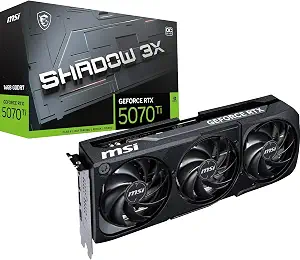
This card is a potential fit for shoppers who want a GeForce RTX 5070 Ti with 16GB GDDR7 memory and a 3-fan design. Its listed memory specification is 16GB GDDR7 (28Gbps/256-bit), and the stated boost clock is Boost: 2482 MHz. Treat these as configuration details for comparing listings, not as a promise about frame rates, temperatures, or results in any particular workload. If you are weighing a Black Friday offer against another configuration, first make sure you are comparing the same model and the same stated specifications.
The product listing also gives a PCIe 5 interface, DisplayPort and HDMI video outputs, and support for a maximum display resolution of 4K UHD (3840×2160). These details are useful when checking a planned system and display setup, but they do not answer every compatibility question. Confirm that the card fits your particular build and that its power arrangement meets the listed requirement before purchasing. The card’s appeal will depend on whether its documented memory, connection, outputs, and fan count line up with your priorities—not on assumptions drawn from the product name.
Choose by the memory specification, not a performance promise
The stated memory configuration gives you a concrete way to decide whether this card belongs on your shortlist: 16GB GDDR7 (28Gbps/256-bit). Consider what you plan to run and whether that specification is a priority in your comparison. The figures alone cannot tell you how a particular title, creative application, or future workload will behave, so avoid treating them as a substitute for workload-specific information. They are most useful as a clear point of reference when comparing the exact Black Friday listing with another card or variant.
If memory capacity is one of your purchase filters, write down the configuration you want before browsing offers. Then check that the listing you are considering names the same card and memory specification. This is a practical way to avoid letting a tempting Black Friday headline distract from the configuration itself. If memory is not a deciding factor for your needs, give more weight to the system checks that matter to you, such as power supply, connection, and display outputs.
Read the boost clock as a listed specification
The stated clock is Boost: 2482 MHz. That number can help distinguish listings when their exact specifications differ, but it does not independently predict the experience you will get. Performance depends on factors that are not established by this product record, so do not use the clock figure alone to rank cards or infer a particular frame rate. Keep it in its proper role: a specification to verify, rather than a measured result or guarantee.
When a Black Friday price comparison is close, first confirm that both listings identify the same model and variant; then compare the specifications you actually value. A clock number is meaningful for that comparison only when you know which product it describes. If the listing wording is unclear, pause rather than assuming that a similar-looking name refers to an identical configuration.
Check the PCIe connection against your build
The listed interface is PCIe 5. Before buying, check the connection details of the system where you plan to install the card and confirm that the listing and your build plans align. The interface specification is useful, but by itself it does not confirm the fit of a complete system or answer every compatibility question. Consult the information for your own components if you are unsure.
This check is especially helpful when shopping quickly during Black Friday, when product names and configurations can be easy to skim. Keep the full model identification beside your notes, and verify the interface on the exact page you intend to buy from. That simple habit helps you compare like with like without assuming that a shared product-family name settles the question.
Plan your screen setup around the listed outputs
The stated video outputs are DisplayPort and HDMI, and the listed maximum display resolution is 4K UHD (3840×2160). Use those facts as a starting point: identify the connections used by your display setup, then check that the exact product listing and your planned arrangement make sense together. The record does not specify output counts, so do not assume a particular number of each connection from the names alone.
A resolution listing also does not guarantee a specific result in every game or application. If 4K UHD (3840×2160) is central to your purchase, treat it as the stated maximum display resolution and research the needs of your intended workload separately. During Black Friday, this distinction helps keep an offer comparison focused on verified details rather than expectations that the listing does not establish.
Make the power requirement a pre-purchase check
The stated minimum is a power supply with min. 750 W. Check your system’s power-supply rating against that requirement before deciding that the card is a practical match. This is a specific planning checkpoint, not a statement about every other part of a power setup; if you need to confirm your system’s suitability, consult the relevant component information rather than inferring it from the wattage alone.
Include this check before comparing Black Friday offers, not after choosing one. A deal is only useful to your plans if the product and the system you intend to use are a workable match. If you cannot verify your power-supply details, make that your next research task. The listed minimum gives you a clear figure to check, while leaving broader system questions for your own component review.
Use the 3-fan detail as one part of the decision
The listing specifies 3 fans. That gives you a straightforward physical-design detail to compare, but it does not establish noise, cooling performance, temperatures, or the card’s dimensions. If those factors matter to your build or preferences, seek product information that addresses them directly instead of drawing conclusions from fan count alone. This keeps the decision tied to what is actually documented.
For a Black Friday shortlist, decide whether the fan configuration is important to you, then balance it against the more immediate checks: the PCIe 5 interface, DisplayPort and HDMI outputs, stated resolution, and minimum power-supply requirement. No single detail makes the purchase decision for every shopper. The useful question is whether the documented configuration fits your priorities and whether you have verified the remaining details that matter for your particular system.
Key specs
| Graphics memory | 16GB GDDR7 (28Gbps/256-bit) |
| GPU clock | Boost: 2482 MHz |
| Interface | PCIe 5 |
| Video outputs | DisplayPort, HDMI |
| Number of fans | 3 |
| Maximum display resolution | 4K UHD (3840×2160) |
| Minimum power supply | A power supply with min. 750 W |
Make your Black Friday choice
Before choosing this card, match its exact listing to your intended setup: confirm the memory and interface, check the DisplayPort and HDMI details against your displays, and verify the power-supply requirement. Treat the clock, resolution, and fan count as specifications—not assurances about results or characteristics the listing does not state. For Black Friday, compare the exact model and variant and evaluate the offer on the information shown for that listing; do not assume a promotion or configuration from a headline. A deliberate compatibility check is more useful than rushing toward an offer that may not fit your plans.